
Insights
Smarter Goals and Why They Matter
March 21, 2026 · 8 min
For a long time, my brain was a graveyard of ambitious sentences.
“I will learn Korean.”
“I will become a 3D designer.”
In the beginning, I loved the rush. There’s a certain high that comes with imagining the future version of yourself. But historically, that energy only lasted about a month. Not because I lost interest or stopped caring, but because I was white-knuckling it on pure motivation, and as I eventually learned, motivation is a terrible fuel for long-term projects.
Life would get busy, the initial spark would fade, and I’d just... stop. I never officially quit; these goals just drifted into the background, becoming things I’d get back to one day that never actually came.
But here’s the thing that kept me up at night: Some of my goals actually worked. I wasn't a total failure at following through. I did manage to become a graphic designer. I did successfully transition into frontend development. I even finally stopped thinking about starting a business and actually built this studio after years of sitting on the sidelines.
Clearly, the ability to finish things was somewhere inside me. But it felt like a glitch in the system. Why did my career goals cross the finish line while things like learning Korean never even left the driveway?
I had to stop and ask myself: What was the secret ingredient in the wins that was missing from the losses?
I used to blame my lack of discipline. I told myself I just didn't want it enough or that I wasn't consistent. Looking back, the reality was much simpler and a little uncomfortable to admit. It was a matter of priority.
Our goals are usually just a reflection of what we value. If you value growth, you’ll reach for a book. If you value stability, you’ll focus on your career. I love learning, so starting Korean felt like a natural fit for my personality.
But I made a mistake: I confused my values with my priorities.
At that time, financial independence was my absolute focus. It was urgent and necessary. Even though I still cared about learning for fun, my survival needs took the wheel. Our behavior is the most honest map of what we actually care about in the moment whether we give it permission to be or not.
Why some goals take over your life
Learning design and frontend development required the same kind of study as Korean, but they had one massive advantage: They were tied to my survival. That necessity changed everything. When a goal is essential, you stop negotiating with yourself. You don't wait for the perfect mood to start, and you don't push it to next Monday the second life gets busy.
These goals became impossible to ignore. They represented the foundation of my future, which gave them a level of gravity that my hobbies simply couldn't match.
I realize now that these career wins had a hidden engine: Architecture. I didn’t just wake up one day and decide to try design. I enrolled in a school. That one decision offloaded all the heavy lifting of staying motivated onto a system that was much bigger than me.
Suddenly, my days had a pre-built script:
- A fixed schedule: My time was already spoken for.
- External expectations: Someone was waiting for me to show up.
- Clear deadlines: Every project had an expiration date.
- Real-world stakes: Slacking off had actual consequences.
I had classes, assignments, and tests that forced me to move. Even on my worst days, the environment carried me forward. Consistency became an automatic byproduct of the system, rather than something I had to manufacture every morning.
Learning Korean was the complete opposite. It existed in a vacuum.
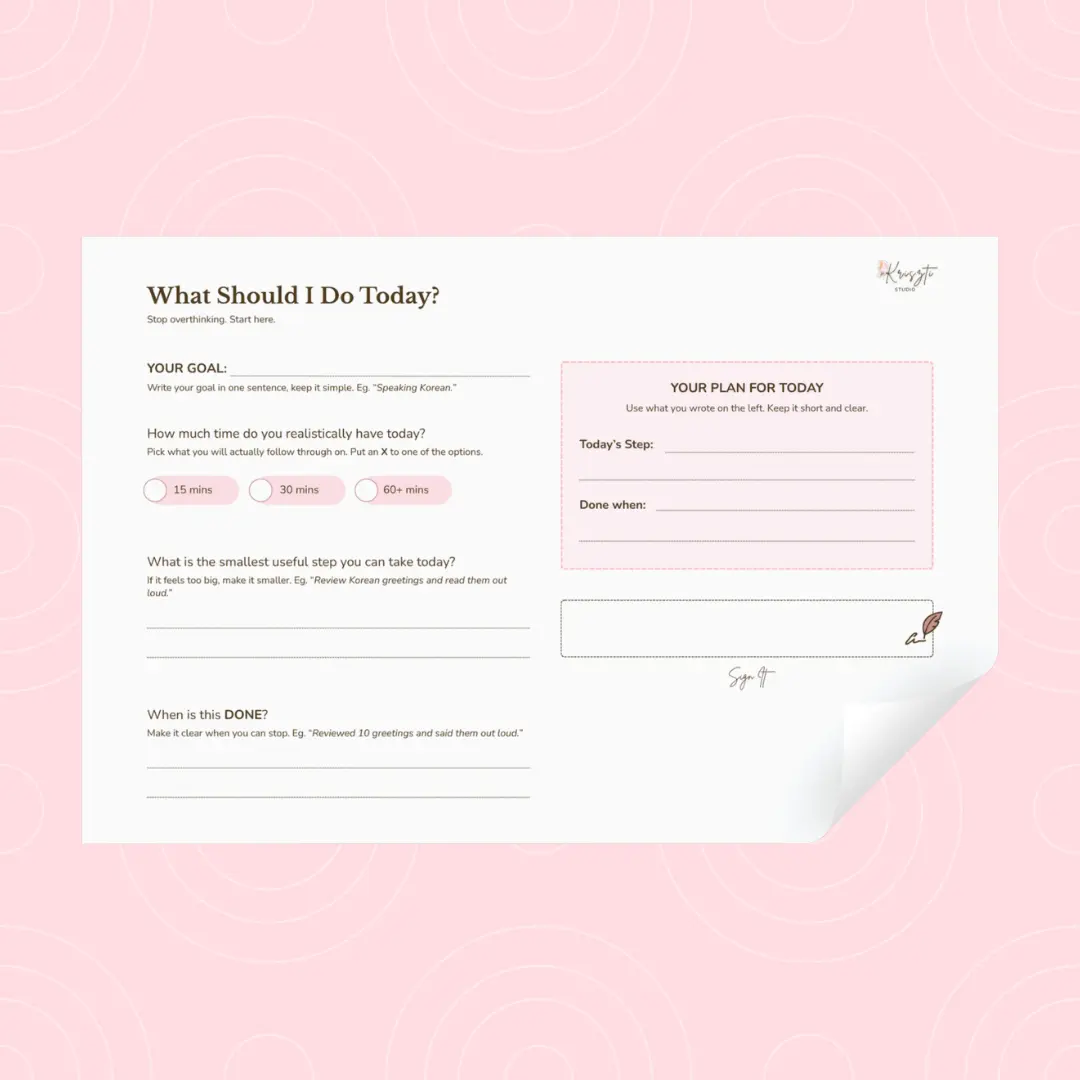
I had no plan, no structure, and zero checkpoints. This meant every single morning started with the same exhausting question: 'What should I do today?'
That question alone was enough to derail me. Without a system to anchor my focus, the most urgent thing in my inbox always won. My Korean textbooks stayed closed simply because there was nothing holding them open. I still cared about the goal, but it was floating in mid-air with no foundation to support it.
This realization changed everything. I finally saw the pattern: my success had nothing to do with my willpower and everything to do with my setup.
I needed to stop treating my goals like vague wishes and start treating them like projects that actually need to run. That meant moving away from the hope for the best strategy and finding a way to build a reliable engine for my progress.
That’s how I found the SMARTER framework. It’s the blueprint I use now to turn a fuzzy idea into a high-functioning system.
Turning a vague idea into something real
Let’s look at my original disaster: 'I want to speak Korean.'
On the surface, it sounds like a goal. But in practice, it’s a black hole. Does speaking mean ordering a coffee, or debating philosophy? Without a finish line, your brain has no idea where to run. You can work for weeks and still feel like you’re standing still, simply because you never defined what forward looks like.
This is exactly where the SMARTER framework earns its keep. It’s a tool that forces you to slow down and actually document the requirements of your success.
Making the goal concrete (Specific + Measurable)
The first step is 'S' (Specific), transforming a vague wish into a scene you can actually picture.
My original goal was just a cloud in my head. To fix it, I had to turn 'I want to speak Korean' into something observable: 'Have a real-time conversation in Korean with another person.'
Suddenly, there’s a person. There’s a setting. But it still needs a success metric. To make it truly 'M' (Measurable), I added a timer: 'Have a 10-minute conversation without switching back to English.'
This changes the entire psychological game. You stop chasing a feeling of getting better and start chasing a binary result. You aren't wondering if you're making progress anymore; you're just asking one question: Did I hit the 10-minute mark? That clarity kills uncertainty. It gives you a solid target to aim for and a clear Yes/No answer when you get there.
Making it sustainable (Achievable + Relevant)
This is the ego check of the framework. It’s so tempting to set goals that look impressive on paper but ignore the reality of your actual life.
I had to stop chasing the ideal version of my goal and start asking: What can I actually maintain on my worst day? That's where 'A' Achievable comes into the picture.
If a 10-minute conversation feels like a mountain, I’ll start with 5 minutes on a single, narrow topic, like just introducing myself. This shift creates a version of the goal that invites momentum rather than dread. A small win that actually happens is infinitely more valuable than a perfect plan that stays in a drawer.
This is also where 'R' Relevance hits hard. You have to be brutally honest about your current bandwidth. If a goal isn't a top priority right now, that's okay. It just means you need to adjust your pace and your expectations to match your real life, not your fantasy version of it.
Giving it direction ('T' Time-bound)
Open-ended goals have a way of staying in draft mode forever. They turn into things you’ll get to eventually, which is usually a polite way of saying you never will.
You have to give your goal a clear boundary: Within 8 weeks.
This one simple constraint creates a sense of movement. Suddenly, you're working toward a specific endpoint. Having a go-live date changes the way you show up every morning; it forces you to prioritize the work today because you know exactly how much time is left on the clock.
When you stack all these layers together, that original wish transforms into a mission: Have a 10-minute conversation in Korean with a native speaker, on a specific topic, staying fully in Korean, within 8 weeks.
The difference is night and day. We moved from a vague, blurry cloud to a target with sharp edges. You no longer have to wake up and wonder what progress looks like; the instructions are already written. You have a goal that is actually actionable, rather than just an idea that feels good to think about.
The part that actually keeps you going (Evaluate + Reward)
Even with a perfect blueprint, things will get messy. You’ll have days where you're exhausted, sessions you'll skip, and moments where progress feels invisible.
Without a way to handle that friction, it’s easy to let the whole goal drift away. This is where 'E' Evaluation acts as your course correction. I’ve started checking in with myself regularly to ask the hard questions:
- Is this plan actually working for my current life?
- Do I need to pivot the strategy? These small reflections let you fix the bugs early, before frustration builds up enough to make you quit.
Then there’s the part we often ignore: 'R' The Reward. We usually obsess over the final result, but the real win is the consistency it took to get there. I’ve started giving myself credit for the boring, unglamorous process of showing up.
Sometimes that reward is just a guilt-free break or doing something I genuinely enjoy. These small payouts reinforce the habit of showing up, especially when motivation is low. They turn the long-term grind into a series of short-term wins that actually feel sustainable.
Build a system, not just a goal
A well-defined goal is just a blueprint. Without an engine to drive it, nothing actually moves. Too many of us design the perfect destination and then wait for it to happen on its own.
The real work happens in the System:
- What does your daily routine actually look like?
- What are your weekly non-negotiables?
- How do you visualize your progress in real-time?
When you build a solid structure, you stop wasting energy deciding what to do next. You don't have to find motivation anymore, you just follow the script.
And one last thing: Life is messy.
You’ll skip a day. You’ll lose your momentum. Something urgent will crash into your schedule and derail your week.
In those moments, it’s easy to feel like the entire goal has failed. But a missed session isn't a total system crash, it’s just a bug that needs a quick fix. You don't scrap the project; you just adjust the parameters and keep moving.
I’m still figuring a lot of this out as I go, but building a real architecture around my goals has changed everything for me.
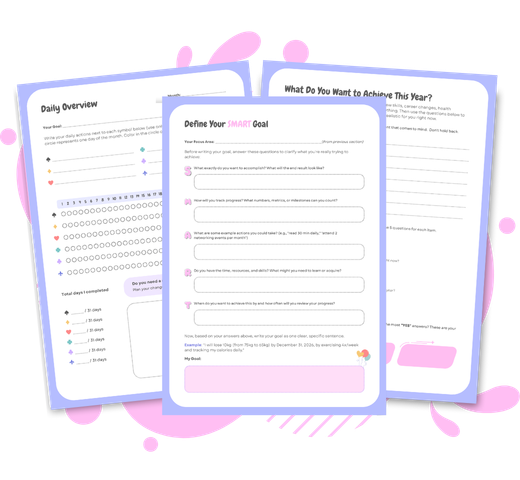
Because I know how hard it is to move from vague idea to finished project, I built a tool to make the process easier. It’s a Mindful Goal Setting Workbook—the exact step-by-step system I use to:
- Audit my values so I know what actually matters.
- Architect my goals using the SMARTER framework.
- Build action plans that survive a busy schedule.
- Track and pivot when life gets in the way.
If you’re looking for a way to stop relying on luck and start relying on a system, this is for you. It’s designed to be the structure you need when your motivation hits a wall.
I’ll be sharing more of these systems as I refine them, so stay tuned. In the meantime, I’d love to see what you build with this.